Cognitive Behavioral Therapy (CBT)

A Complete and Detailed Guide to Cognitive Behavior Therapy (CBT):
An Introduction to Cognitive Behavioral Therapy
Cognitive Behavioral Therapy (CBT) is one of the best-studied, most effective, and most evidence-based types of therapy available today. It is a structured, goal-oriented, and time-limited way of treating people that looks at how thoughts, feelings, and actions are connected. CBT is based on the idea that negative thoughts and behaviors are the main causes of mental pain. People who change these patterns can feel better emotionally and do better in their daily lives.
Psychiatrist Aaron T. Beck came up with CBT in the 1960s. Since then, it has become a flexible therapy model that can be used to treat many different mental health issues. Today, the World Health Organization (WHO) and the American Psychological Association (APA) are two of the most important health organizations in the world that recommend it.
What are Core Ideas Behind Cognitive-Behavioral Therapy?
There are a few basic ideas that guide the practice of CBT:
Thoughts can change how you feel and act.
Not the situations themselves, but how people think about them affects how they feel and act.
Some mental or psychological behaviors are learned.
Personal experiences often cause maladaptive cognitive patterns and behaviors.
Learned maladaptive behaviors can be different.
People can learn to think and act in healthier ways by becoming more aware, practicing, and using structured methods.
Approach that focuses on the present
CBT focuses on problems that are happening right now instead of going into great detail about past experiences.
Working together with others
The therapist and client work together to set goals and come up with ways to deal with problems.
Cognitive Model: What you think, how you feel, and what you do?
The cognitive model is the main idea behind CBT. It shows how thoughts, feelings, and actions are all connected.
- An external event or trigger is the situation.

- Thoughts cause automatic interpretations of the situation.
- Emotions are the feelings that come from our thoughts.
- Emotions and thoughts affect how people behave.
For instance, someone who thinks, “I am a failure” after making a small mistake might feel anxious or depressed and stay away from future challenges. CBT helps people notice these automatic thoughts and replace them with more balanced and realistic ones.
What is difference between Automatic and distorted thoughts?
Automatic Thoughts
Automatic thoughts are thoughts that come to mind without any effort on your part. They are often negative. They are usually short but strong, and they can change your mood a lot.
Distorted Thoughts
Cognitive distortions are wrong or illogical ways of thinking that make bad feelings worse. Some common distortions are:
- All-or-nothing thinking means seeing things in black and white.
- Catastrophizing is the act of thinking the worst will happen.
- Overgeneralization means making big conclusions based on just one event.
- Mind reading: Taking for granted that you know what someone else is thinking without any proof.
- Emotional reasoning is the idea that feelings are facts.
CBT helps clients find and question these false beliefs by using structured questions and evidence-based reasoning.
The Behavioral Component of CBT:
Cognition is a key part of CBT, but changing behavior is also important. People can use behavioral techniques to stop avoiding things, being afraid, and doing things that are bad for them.
Some important behavioral strategies are:
- Behavioral activation means getting people to do things that are fun or important.
- Exposure therapy is when you slowly expose yourself to things that make you anxious to help you feel less anxious.
- Skill training means teaching people how to solve problems, talk to people, and deal with stress.
- Changing your habits means replacing bad ones with good ones.
Changing how people act often makes them feel better and think more clearly.
What is structure of CBT Sessions?
CBT usually only lasts for a set amount of time, usually between 6 and 20 sessions, depending on the condition and how bad it is.
The following are common parts of a CBT session:
- Check in on your mood.
- Look over the last session and the homework.
- Setting the agenda.
- Talk about the big problems
- Exercises for the mind or behavior.
- Assignment for homework.
- Summary of the session and feedback.
Homework is an important part of the program because it lets clients use what they’ve learned in real-life situations.
Which mental conditions are treated with Cognitive Behavioral Therapy?
CBT works for many mental health and psychological issues, such as:
Anxiety Disorders
Generalized Anxiety Disorder (GAD)
Panic disorder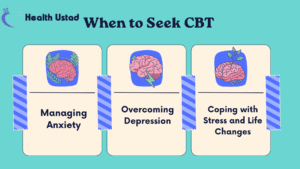
Anxiety about social situations
Fear of things
Obsessive Compulsive Disorder (OCD)
Disorders of Mood
Major Depressive Disorder
Persistent Depression Disorder (Dysthymia)
Bipolar Disorder (as an additional treatment)
Disorders Related to Trauma
Post-Traumatic Stress Disorder (PTSD)
Eating problems.
Anorexia nervosa
Bulimia Nervosa
Eating Disorder: Binge Eating
Avoidant/restrictive Food Intake Disorder (ARFID)\
Other Conditions
Insomina
Chronic pain
Addiction
Anger management
Stress
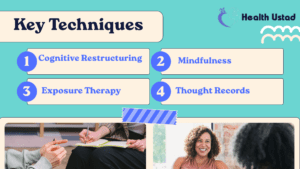
What Techniques are used in CBT?
CBT uses a number of useful methods, such as:
Thought Restructuring:
This is the process of finding negative thoughts and replacing them with more balanced ones.
Thought Records:
Worksheets to write down situations, thoughts, feelings, and logical responses.
Behavioral Experiments:
Experiments in real life are used to test beliefs and see if they are true.
Relaxation Techniques:
- Deep Breathing.
- Progressive Muscle Relaxation
- Mindfulness
Different Types of CBT
There are many ways to give CBT to meet different needs:
- Individual CBT.
- Group CBT.
- CBT that is done online or over the internet (CBT).
- CBT programs for self-help.
- CBT based Mobile apps.
Digital CBT has become more popular because it is easy to use and cheap.
What are the strengths and benefits of CBT?
CBT has a lot of advantages:
- A lot of scientific evidences.
- Short-term, planned.
- Based on skills and real life.
- Let people help be their own therapists.
- Works well with people of all ages and cultures.
- Can be used with other drugs.
What are Cognitive Behavioral Therapy’s Limits?
Cognitive behavioral therapy is effective, but it does have some drawbacks:
- Require active participation.
- Needs people to be involved.
- Some people might think it is too structured.
- Less focus on exploring deep emotions.
- For some clients, homework can be hard.
- Not good for people with serious cognitive problems.
A trained therapist can adapt CBT techniques to fit each person’s needs.
What is the role of Therapist in CBT?
The CBT therapist is not an authority figure; instead, they are a guide, teacher, and partner. The therapist helps people:
- Find thoughts and actions that are causing problems.
- Learn how to deal with things, learn coping stratgies.
- Practice your skills.
- Keep an eye on progress.
- Stop relapsing.
During treatment, therapists stay supportive and don’t judge.
CBT & Relapse Prevention:
An important part of cognitive behavioral therapy is teaching people how to avoid relapsing. The clients learn:
- Know the early warning signs.
- Use the skills you learned on your own.
- Make plans for how to deal with things in the long term.
- Keep what you’ve learned after therapy ends.
This focus on self-management makes CBT very sustainable.
What are Cultural Adaptation for CBT?
Cognitive Behavioral Therapy (CBT) has been effectively implemented across diverse cultures and belief systems. Therapists combine:
- Cultural Values
- Beliefs about religion
- Language Preferences
- Family Systems
CBT works well with a lot of different groups of people, such as South Asian and Muslim communities, because it can be used in many different ways.
CBT and Other Therapies:
Cognitive Behavioral Therapy vs. Psychoanalysis.
- CBT is organized and lasts a short time.
- Psychoanalysis is long-term and focuses on gaining insight.
CBT and Humanistic Therapy
- CBT is all about thoughts and actions.
- Humanistic therapy is all about feelings and accepting yourself.
Cognitive Behavioral Therapy vs. Dialectic Behavioral Therapy
- DBT have more focus on developing coping with stress and managing emotions.
- CBT help in developing cognition.